Convert MWh to kWh instantly
Enter a Megawatt-hour (MWh) value and get the Kilowatt-hour (kWh) result. The conversion factor is 1 MWh = 1,000 kWh.
Convert Megawatt-Hours Into Kilowatt-Hours
The MWh to kWh conversion formula and how to apply it
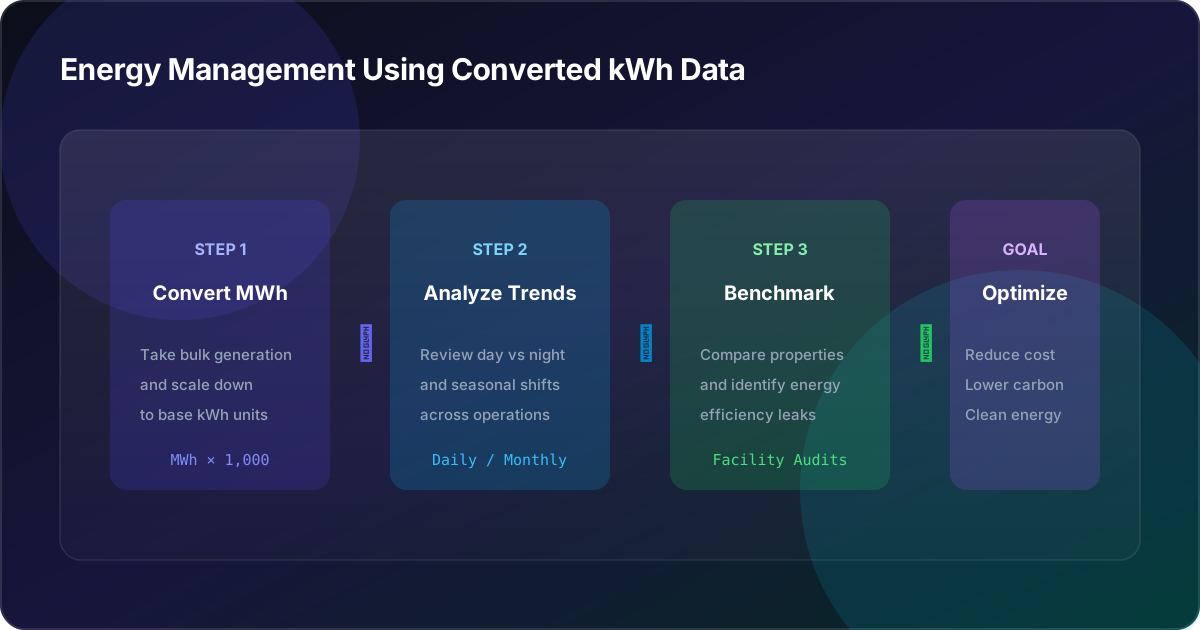
One Megawatt-hour (MWh) equals 1,000 Kilowatt-hours (kWh). The MWh to kWh conversion formula is: kWh = MWh × 1,000. Multiply any Megawatt-hour value by 1,000 to get the equivalent in Kilowatt-hours. The reverse kWh to MWh formula is: MWh = kWh ÷ 1,000.
The conversion factor of 1,000 comes from the International System of Units (SI). The prefix "Mega" represents 10⁶ (1,000,000) and the prefix "Kilo" represents 10³ (1,000). The ratio between Megawatt-hours and Kilowatt-hours is 10⁶ ÷ 10³ = 10³ = 1,000. This ratio holds for all energy unit conversions in the watt-hour family: 1 GWh (Gigawatt-hour) = 1,000 MWh = 1,000,000 kWh.
Common MWh to kWh examples: 0.01 MWh = 10 kWh, 0.15 MWh = 150 kWh, 0.66 MWh = 660 kWh, 1.17 MWh = 1,170 kWh, 2.4 MWh = 2,400 kWh, 100 MWh = 100,000 kWh, and 200 MWh = 200,000 kWh. For the reverse direction: 2,000 kWh = 2 MWh and 20,000 kWh = 20 MWh.
What Is a Megawatt-Hour?
A unit of energy equal to 1,000 kilowatt-hours
A Megawatt-hour (MWh) is a unit of electrical energy equal to 1,000 Kilowatt-hours (kWh) or 1,000,000 Watt-hours (Wh). One MWh represents the amount of energy produced or consumed when a 1 Megawatt (MW) load operates for 1 hour.
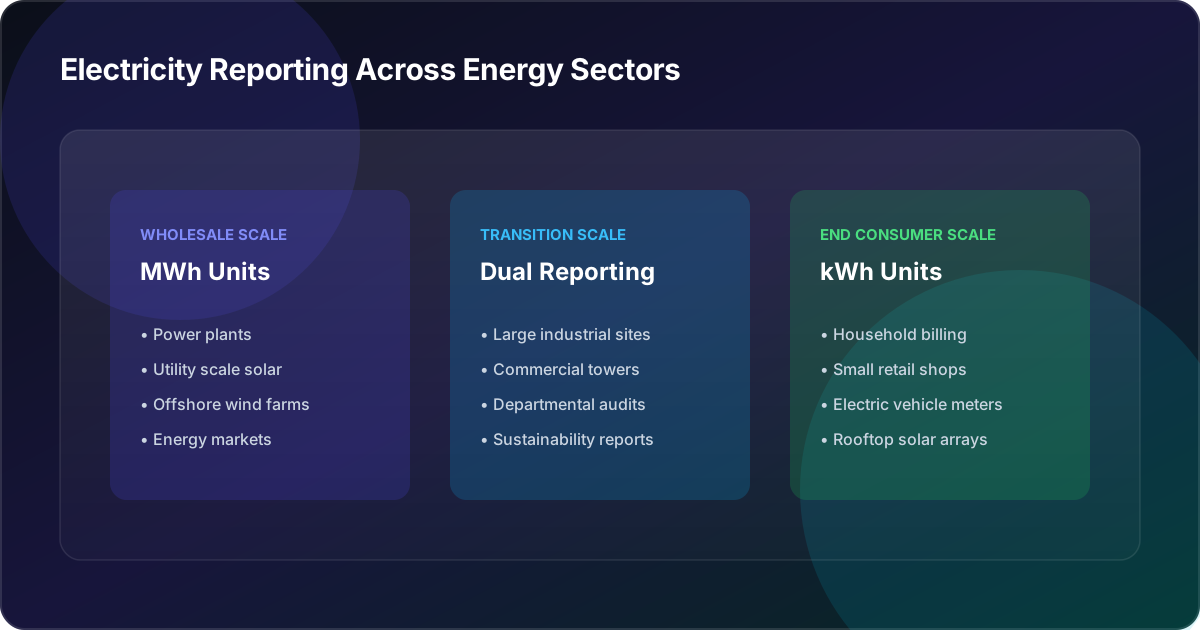
Power plants, solar farms, wind farms, and hydroelectric dams report their electricity generation in MWh. Utility companies trade electricity on wholesale markets in MWh. Grid storage systems rate their capacity in MWh. A typical 5 MW wind turbine operating at 30% capacity factor generates about 13,140 MWh (13,140,000 kWh) per year.
1 MWh powers approximately 330 US homes for one hour, or one average US home for about 34 days, based on the national average consumption of 886 kWh (0.886 MWh) per month.
Powers 330 homes for 1 hour
What Is a Kilowatt-Hour?
The standard unit on residential electricity bills
A Kilowatt-hour (kWh) is a unit of electrical energy equal to 1,000 Watt-hours (Wh). One kWh represents the energy consumed when a 1,000-watt (1 kW) appliance runs for 1 hour. Utility companies use kWh as the standard billing unit on residential electricity bills worldwide.
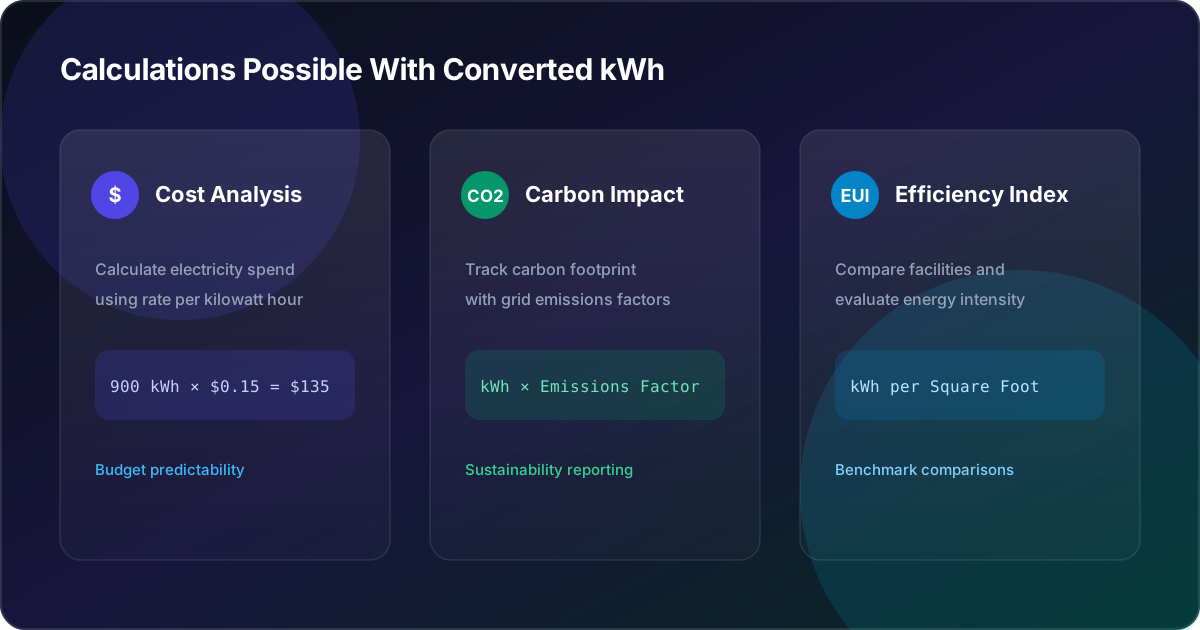
Smart meters installed by utility companies record electricity consumption in kWh. The meter reading at the end of a billing period minus the reading at the start gives the total kWh consumed. The utility multiplies this figure by the rate per kWh — typically between $0.10 and $0.35 in the United States — to calculate the electricity bill amount.
One kWh equals 0.001 MWh. An average US household consumes about 886 kWh (0.886 MWh) per month, or approximately 10,632 kWh (10.632 MWh) per year.
Click appliances to see their hourly kWh consumption:
Electricity Consumption Measured in MWh and kWh
How homes, businesses, and factories use energy at different scales
Electricity consumption varies by 3 orders of magnitude between residential, commercial, and industrial sectors. Homes consume electricity in the hundreds to low thousands of kWh per month. Commercial buildings consume tens of thousands of kWh (tens of MWh) per month. Industrial facilities consume hundreds of thousands of kWh (hundreds of MWh) per month.
The average US household consumes 886 kWh (0.886 MWh) per month. A medium-sized office building consumes about 8,300 kWh (8.3 MWh) per month. A large manufacturing plant consumes about 83,000 kWh (83 MWh) per month. Utility companies track all 3 sectors in MWh for grid load balancing and peak demand metering.
Reading Energy Usage in Different Units
Switch between Wh, kWh, MWh, and GWh on a single meter display
Energy meters display consumption in 4 units within the watt-hour family: Wh, kWh, MWh, and GWh. Smart meters installed by utility companies record the same electricity reading. The display unit changes the scale of the number shown.
A reading of 10,632 kWh equals 10,632,000 Wh, 10.632 MWh, and 0.010632 GWh. Residential smart meters display kWh. Commercial and industrial meters display MWh. Grid-level energy analytics and transmission loss reports use GWh (1 GWh = 1,000 MWh = 1,000,000 kWh).
Utility billing, time-of-use tariff calculations, and demand charge calculations use kWh for residential customers and MWh for commercial and industrial customers. The conversion between all units uses factors of 1,000.
Click a unit to see the same energy reading in different scales
MWh to kWh Conversion Table
Reference values covering related search queries from 0.01 MWh to 20,000 MWh
| MWh | kWh | Typical Equivalent |
|---|---|---|
| 0.01 MWh | 10 kWh | ~8 hours of air conditioning |
| 0.03 MWh | 30 kWh | ~3 days of household electricity |
| 0.04 MWh | 40 kWh | ~Full charge of a 40 kWh EV battery |
| 0.15 MWh | 150 kWh | ~5 days of residential power |
| 0.18 MWh | 180 kWh | ~6 days of household electricity |
| 0.19 MWh | 190 kWh | ~1 week of residential consumption |
| 0.2 MWh | 200 kWh | ~1 week of residential consumption |
| 0.5 MWh | 500 kWh | ~2 weeks of residential power |
| 0.66 MWh | 660 kWh | ~3 weeks of household electricity |
| 0.7 MWh | 700 kWh | ~3 weeks of household electricity |
| 1 MWh | 1,000 kWh | ~1 month of household electricity |
| 1.17 MWh | 1,170 kWh | ~5 weeks of residential power |
| 1.18 MWh | 1,180 kWh | ~5 weeks of residential power |
| 1.4 MWh | 1,400 kWh | ~6 weeks of residential electricity |
| 1.8 MWh | 1,800 kWh | ~2 months of residential power |
| 2 MWh | 2,000 kWh | ~2 months of residential power |
| 2.1 MWh | 2,100 kWh | ~2 months of residential power |
| 2.4 MWh | 2,400 kWh | ~2.5 months of household electricity |
| 2.9 MWh | 2,900 kWh | ~3 months of residential power |
| 5 MWh | 5,000 kWh | ~Annual electricity for a 2-person home |
| 10 MWh | 10,000 kWh | ~Annual power for a large family home |
| 11 MWh | 11,000 kWh | ~Average US household annual consumption |
| 15 MWh | 15,000 kWh | ~Annual power for a home with heat pump |
| 100 MWh | 100,000 kWh | ~Medium office building yearly consumption |
| 120 MWh | 120,000 kWh | ~Large commercial facility annual use |
| 130 MWh | 130,000 kWh | ~Small industrial plant yearly power |
| 200 MWh | 200,000 kWh | ~Medium industrial facility annual use |
| 1,000 MWh | 1,000,000 kWh | = 1 GWh (Gigawatt-hour) |
| 2,000 MWh | 2,000,000 kWh | = 2 GWh — small wind farm annual output |
| 20,000 MWh | 20,000,000 kWh | = 20 GWh — utility solar farm annual yield |
FAQ's
Answers to the most common questions about MWh and kWh energy unit conversions
How many kilowatt-hours are in one megawatt-hour? +
There are exactly 1,000 Kilowatt-hours (kWh) in one Megawatt-hour (MWh). The prefix "Mega" represents 1,000,000 watts and the prefix "Kilo" represents 1,000 watts in the International System of Units (SI).
What does MWh measure in an electricity system? +
A Megawatt-hour (MWh) measures electrical energy — the total amount of electricity generated or consumed over time. Power plants report output in MWh. Utility companies use MWh for wholesale electricity trading.
What does kWh represent on an electricity bill? +
A Kilowatt-hour (kWh) represents the amount of electrical energy a household consumes during a billing period. Smart meters record consumption in kWh.
Is MWh a unit of energy or power? +
MWh is a unit of energy, not power. Power is measured in watts (W), kilowatts (kW), or megawatts (MW). Energy is measured in watt-hours (Wh), kilowatt-hours (kWh), or megawatt-hours (MWh).
Why are large power stations described using MWh? +
Large power stations use MWh because their output is too large to express in kWh. Writing 12,000 MWh is clearer than writing 12,000,000 kWh.
How can I convert electricity production from MWh to kWh? +
Multiply the MWh value by 1,000 to get kWh. The MWh to kWh formula is: kWh = MWh × 1,000. For example, 3.5 MWh × 1,000 = 3,500 kWh.
What is 2 MWh expressed in kilowatt-hours? +
2 MWh = 2,000 kWh. Apply the formula: 2 MWh × 1,000 = 2,000 kWh. This amount equals roughly 2 months of electricity consumption for an average household.
Why do homes usually use kWh instead of MWh? +
Homes use kWh because monthly residential consumption falls within the hundreds or low thousands of kilowatt-hours.
Can decimal MWh values be converted into kWh? +
Yes, multiply any decimal MWh value by 1,000 to get kWh. Examples: 0.01 MWh = 10 kWh, 0.15 MWh = 150 kWh, and 2.4 MWh = 2,400 kWh.
Can I convert kWh back to MWh? +
Yes, divide the kWh value by 1,000 to get MWh. The kWh to MWh formula is: MWh = kWh ÷ 1,000. Examples: 2,000 kWh ÷ 1,000 = 2 MWh.